Complete Guide: Key Symptoms of Fuel Injector Failure and How to Save Your Engine from Breakdown
Complete Guide: Key Symptoms of Fuel Injector Failure and How to Save Your Engine from Breakdown
Fuel injectors are the beating heart of your car’s engine. They are responsible for delivering extremely precise amounts of fuel into the combustion cylinders. Even a minor malfunction in these delicate components can completely disrupt your vehicle’s performance.
In this article, I share my in-depth technical experience on the symptoms of failing fuel injectors and how to deal with them before they turn into an expensive problem.
How Can You Tell If Your Car Is Showing Symptoms of Faulty Fuel Injectors?
Throughout my years working in engine maintenance, I’ve noticed that injectors rarely fail suddenly. Instead, they usually send out clear warning signs first. Understanding these signals is your key to protecting your engine.
Engine Misfires and Abnormal Vibrations
Misfiring is the most common symptom. You’ll feel it as shaking or hesitation while driving. This happens when one injector fails to deliver the correct amount of fuel, preventing the cylinder from completing proper combustion.
In severe cases, you may hear popping or knocking sounds caused by unbalanced combustion.
Engine Vibration at Idle
Do you notice your steering wheel vibrating while stopped at a traffic light? This is known as rough idle. A clogged or dirty injector delivers fuel intermittently, preventing the engine from running smoothly at low RPMs.
In my experience, this symptom is often accompanied by fluctuating engine sound.
Loss of Power and Sluggish Acceleration
If you press the accelerator and the car feels heavy or slow to respond, the injectors are often the first suspects. Blockage prevents enough fuel from reaching the engine to generate the required power.
You’ll especially notice reduced horsepower when climbing hills or overtaking on highways.
What Are the Real Causes Behind Fuel Injection System Failure?
Injectors don’t fail without reason. Certain habits and chemical factors accelerate their wear and shorten their lifespan.
Carbon Deposits and Dirt Buildup
Carbon buildup is the number one cause. After the engine is shut off, fuel leaves gummy residues due to residual heat. These residues clog the extremely fine micro-nozzles of the injectors.
Over time, the spray pattern changes, causing the injector to drip instead of producing a fine mist.
Using Contaminated or Low-Quality Fuel
Cheap fuel or fuel contaminated with water and impurities damages the internal injector components. Dirt particles act like sandpaper on delicate internal valves, while water causes corrosion and rust.
Neglecting Regular Fuel Filter Replacement
The fuel filter’s job is to protect the injectors. When the filter becomes clogged, fine particles pass through and settle inside the injectors.
I’ve seen injectors completely fail simply because the owner neglected to replace the fuel filter on time.
How Can You Diagnose Fuel Injector Problems Yourself?
Before visiting a mechanic and spending unnecessary money, there are a few checks you can perform yourself.
Using an OBD-II Diagnostic Scanner
Modern diagnostic tools make troubleshooting much easier.
- Fault codes from P0201 to P0208 indicate an electrical problem in a specific injector.
- Codes from P0300 to P0308 indicate misfires, often caused by clogged injectors.
Simple Mechanical Listening Test
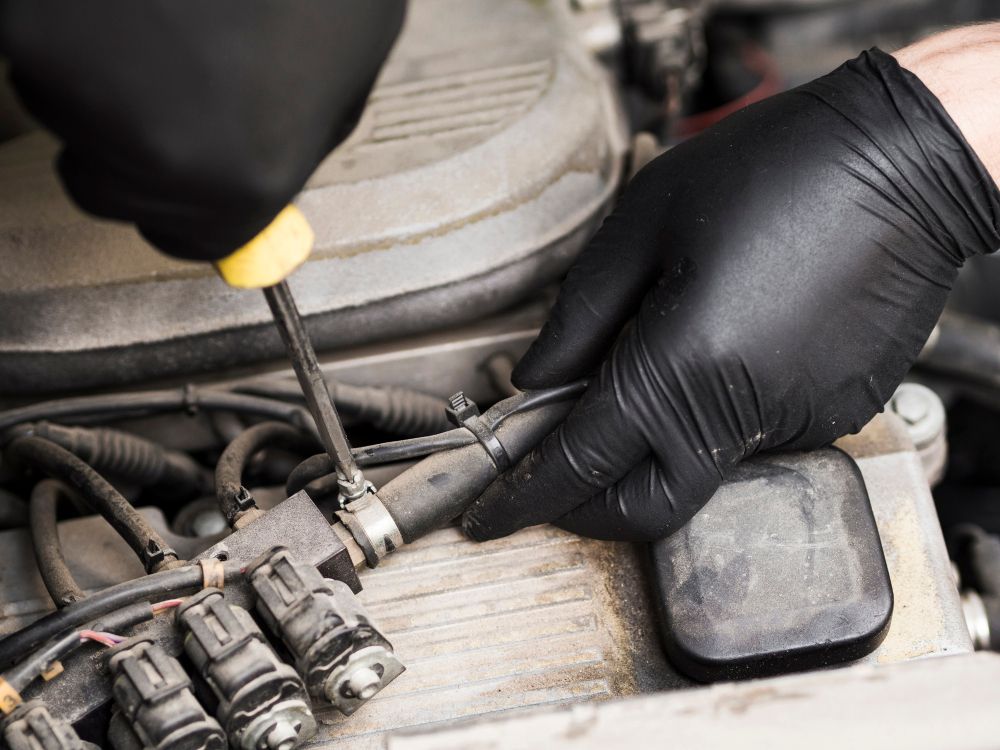
Use a long screwdriver and place its metal tip on the injector body while the engine is running. Place your ear on the handle.
A healthy injector produces a consistent clicking sound. If the sound is weak or absent, the injector may be mechanically stuck or electrically faulty.
Measuring Electrical Resistance with a Multimeter
This test is for advanced users. Disconnect the injector connector and measure resistance in ohms.
For most gasoline engines, normal readings range between 12 and 17 ohms. A zero or infinite reading means the injector is electrically damaged and must be replaced.
Why Do Symptoms Differ Between GDI and Diesel Engines?
Not all engines operate the same way. Gasoline Direct Injection (GDI) and diesel engines have their own specific issues.
Carbon Buildup Issues in GDI Engines
In GDI engines, fuel is injected directly into the cylinder. The major downside is carbon buildup on intake valves, since fuel no longer washes over them as it did in older systems.
This buildup causes misfires and power loss that closely mimic injector failure. The most effective solution is walnut blasting to remove hardened carbon deposits.
Excessive Return Flow in Diesel Injectors
Diesel engines operate under extremely high pressure, sometimes exceeding 2,500 bar. When a diesel injector fails, it often begins leaking internally, causing excessive fuel return.
This prevents the system from building sufficient pressure, leading to very difficult cold starts.
Serious Consequences: What Happens If You Ignore Injector Failure Symptoms?
Ignoring injector problems isn’t just a driving inconvenience—it poses a serious financial risk.
Engine Oil Dilution with Fuel
When an injector leaks while closed, fuel can slip past the pistons into the oil pan. Fuel breaks down oil viscosity, leading to accelerated engine wear.
A strong fuel smell on the oil dipstick is a clear warning sign.
Catalytic Converter Damage
Unburned fuel from a faulty injector flows directly into the catalytic converter, where it ignites due to extreme heat. This can cause the converter to melt and become completely blocked.
Replacing a catalytic converter often costs far more than replacing injectors.
Practical Guide to Preventive Maintenance for Fuel Injectors
Prevention is always cheaper than repair. Here are practical steps I personally follow to keep injectors healthy.
Using High-Quality Fuel Additives (PEA)
I recommend using a fuel cleaner containing Polyetheramine (PEA) every 30,000 km. This chemical is powerful enough to break down hardened carbon deposits before they cause full blockage.
Replacing the Fuel Filter on Schedule
Don’t wait for problems to appear. Follow the manufacturer’s maintenance schedule for fuel filter replacement. A clean filter ensures no microscopic debris reaches the injector nozzles.
Avoid Driving with a Nearly Empty Fuel Tank
Driving on low fuel causes the pump to draw sediment from the bottom of the tank. These deposits are the primary enemies of injectors and can quickly clog their internal filters.
Frequently Asked Questions About Fuel Injector Failure Symptoms
Can faulty injectors be cleaned, or must they be replaced?
If the blockage is carbon-related or minor, ultrasonic cleaning delivers excellent results. However, if the internal electrical coil is damaged, replacement is the only solution.
What’s the difference between black smoke and white smoke caused by injectors?
Black smoke indicates a rich fuel mixture, meaning the injector is delivering too much fuel.
White smoke, especially in diesel engines, may indicate a leaking injector spraying liquid fuel that doesn’t fully burn.
When should injectors be cleaned as preventive maintenance?
Experts recommend cleaning injectors or using fuel additives every 40,000 to 50,000 km to maintain optimal performance.
Do faulty injectors trigger the “Check Engine” light?
Yes, absolutely. The ECU detects combustion imbalance or electrical faults in the injector circuit and immediately turns on the warning light.
Why does raw fuel smell enter the cabin?
The most common cause is damaged injector O-rings, which allow fuel to leak onto the hot engine surface and evaporate.
Conclusion: The Path to a Long-Lasting Engine
Monitoring fuel injector failure symptoms is essential for any vehicle owner who wants to avoid costly repairs.
A slight vibration today could lead to a clogged catalytic converter or severe engine damage tomorrow. Use trusted fuel additives, high-quality fuel, and follow regular maintenance schedules.
Have you noticed any of these symptoms in your vehicle recently? Share your experience and help others protect their engines by spreading this knowledge.